Microinverters vs String Inverters The Real Reason Your Solar Output Is Dropping
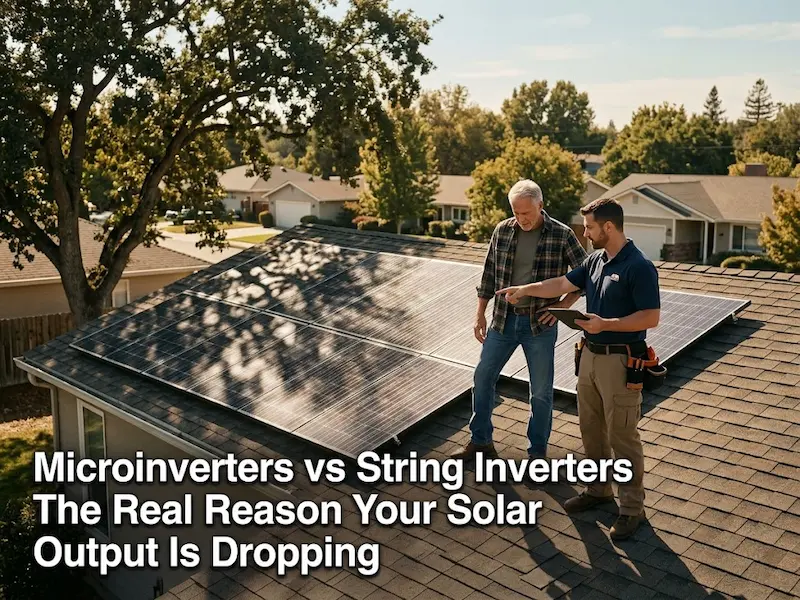
If you are comparing microinverters vs string inverters, the scary question is usually the same: can one shaded panel really drag down the electricity production of your entire roof? The answer is more nuanced than the usual solar sales pitch.
Advertisements
A conventional string system can be affected by an underperforming panel, while a microinverter architecture gives each panel independent DC-to-AC conversion.
1. Microinverters vs String Inverters And What Actually Happens When Your Roof Gets Shade

The basic difference is where the conversion happens. A string inverter receives DC electricity from a group of panels and converts it centrally, while a microinverter performs that conversion at the individual panel level. The U.S. Department of Energy describes string systems as cost-effective but notes that shading or another panel-level problem can reduce production from the associated string.
Advertisements
Why One Weak Panel Can Matter
A string is essentially a group of panels working together. Modern panels and inverter controls can reduce the consequences of partial shade, so it is wrong to claim that one leaf automatically shuts down an entire solar array. However, panels with significantly different operating conditions can still make string-level optimization less effective.
Microinverters take a different approach. Each panel can operate independently, meaning a shaded or malfunctioning module does not directly dictate the operating point of the other panels. This is the real technical reason microinverters are attractive for roofs with complicated shade patterns.
What NREL Found Under Partial Shade
This is where the debate gets more interesting than marketing claims. In an NREL test comparing an 8 kW string-inverter system with a microinverter system under simulated partial shading, the microinverter system showed approximately 4% relative annual performance improvement under light shade, 8% under moderate shade, and 12% under heavy shade.
Those numbers should not be treated as a guaranteed percentage for every home because roof orientation, shade movement, module characteristics, and system design are different. But they demonstrate why panel-level electronics can become valuable when shade is genuinely part of the site.
The Catch Is Cost And Roof Access
Microinverters are usually more expensive upfront and place more electronics on the roof. If a component needs replacement, the technician may need roof access rather than simply opening a wall-mounted inverter enclosure. EnergySage also notes that microinverters can make future expansion and panel-level diagnostics easier.
2. Shading Losses And Energy Output Drop Depend More On Your Roof Than The Inverter Label


Before spending extra money, look at the roof. A large, simple roof with consistent sunlight throughout the day is a very different installation from a roof divided into several orientations with trees, chimneys, dormers, and neighboring buildings. EnergySage recommends conventional string inverters particularly for simpler roofs with little shading, while panel-level optimization becomes more compelling on complicated roofs.
Here is the practical comparison:
| Factor | String Inverter | Microinverter |
| Conversion | Centralized | At panel level |
| Shade tolerance | Lower | Higher |
| Monitoring | Usually string/system level | Panel level |
| Upfront cost | Usually lower | Usually higher |
| Roof electronics | Minimal | More electronics |
| Single inverter failure | Can affect connected system | Usually affects only associated panel |
| Complex roof | Less ideal | Strong fit |
| Future panel expansion | Depends on inverter capacity | Generally flexible |
| Typical warranty pattern | Often around 10–12 years | Often around 25 years |
Warranty is an important part of the calculation. EnergySage reports that traditional string inverters commonly carry around 10–12 years of coverage, while microinverters and power optimizers often have warranties around 25 years, although labor and shipping terms vary considerably by manufacturer.
That means the cheapest quote is not automatically the cheapest system over its useful life. You should compare equipment price, labor coverage, replacement access, monitoring, battery compatibility, and installer support rather than looking at the inverter price alone.
If you want to understand what happens before these components reach your roof, this guide to modern solar charging and photovoltaic manufacturing is useful background on how the broader solar hardware ecosystem is evolving.
3. Centralized Inverter Failure And Panel Level Monitoring Can Change The Maintenance Equation

One of the biggest differences appears when something actually goes wrong. A centralized inverter concentrates an important part of the conversion system into one piece of equipment, while microinverters distribute that function across the array. DOE notes that inverter-related issues account for a significant share of PV downtime and maintenance, making inverter reliability and diagnostics worth taking seriously.
When A Central Inverter Becomes The Bottleneck
A centralized inverter failure can stop the affected system from converting solar DC into usable AC electricity until the problem is fixed. With microinverters, a single failed unit normally affects its associated panel rather than taking down the entire array.
That does not mean microinverters cannot fail. There are simply more individual electronic components, so the trade-off is between distributed failure impact and having more equipment installed outdoors.
Panel Level Monitoring Is A Real Advantage
Panel level monitoring lets owners and installers see how individual modules are performing rather than relying only on total system production. DOE notes that PV monitoring platforms can provide alarms and identify abnormal operating conditions, while microinverter systems commonly integrate monitoring at the module level.
This becomes especially useful when one panel starts producing less than its neighbors. Instead of guessing whether the problem is dirt, shade, wiring, module damage, or electronics, the installer has better diagnostic information.
So Which One Should You Buy?
Choose a string inverter when your roof is simple, mostly unshaded, and keeping upfront costs down is important. Choose microinverters when shade, multiple roof orientations, panel-level diagnostics, or flexible expansion are major priorities.
There is also a middle ground. Power optimizers combine panel-level optimization with a centralized inverter, giving homeowners some of the shade-management and monitoring benefits without completely moving DC-to-AC conversion onto the roof.
My practical recommendation is simple: do a shade analysis before choosing the inverter architecture. If an installer recommends microinverters without showing how your roof’s shade pattern affects production, or recommends a cheap string inverter without discussing roof orientation, ask for a system-specific explanation before signing.
The biggest microinverters vs string inverters lesson is that the better technology is not automatically the better purchase. The right system is the one that matches your roof, shade, budget, maintenance expectations, and long-term energy goals.
Q&A
Does a microinverter completely eliminate shade losses?
No. The shaded panel still receives less sunlight, so that panel cannot produce the same energy as it would in full sun. Microinverters mainly prevent the underperforming panel from having the same level of influence over other panels.
Are microinverters better for every residential solar system?
Not necessarily. A simple, sunny roof can make a conventional string inverter a very sensible choice because it can cost less and keep the main electronics accessible. The additional cost of microinverters makes more sense when the roof has shading, multiple orientations, or a strong need for individual monitoring.
Should I replace my inverter if solar production suddenly falls?
Not immediately. First check weather, new shade, panel cleanliness, system alerts, historical production, and whether the decline affects the entire system or only part of it. Monitoring data can help an installer determine whether the actual problem is the inverter, a panel, wiring, or changing site conditions.


